What Is the Evil Eye? Meaning, Origins and Modern Beliefs
The evil eye explained in plain English: where the belief comes from, what different cultures say it does, and how I look at envy and admiration in my practice.
 Eleonora · · 5 min read

The evil eye is a belief that a hostile or envious look can bring harm or bad luck to the person it falls on. Traditions across the Mediterranean, the Middle East, Latin America and Slavic regions describe it, often with amulets or words of blessing. In my practice I approach the belief with respect and look at what a reading shows.
What the evil eye means in plain words
The phrase describes a look, usually one given out of envy or from very strong admiration, that is believed to carry harm. Many people do not take it literally. For some it is simply a way of talking about jealousy between people. For others it is a family custom they grew up with.
The word eye points to the gaze itself. The belief is about attention and feeling rather than a physical act. That is why it sits so close to everyday life: a compliment, a look across a room or a sudden silence can all feel loaded to someone who already feels watched.
The idea is easy to understand, because most of us have felt the sting of someone else's jealousy or been on the receiving end of a sharp comment. The belief gives that experience a name and a set of traditional responses.
Where the belief comes from
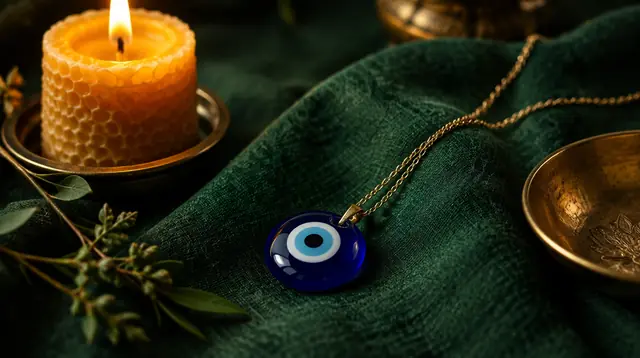
Versions of the evil eye appear in Mediterranean, Middle Eastern, Latin American and Slavic traditions, and in many communities that have moved across the world. The belief is old and widely shared, but it takes different forms in each place. Blue eye amulets are a familiar example in parts of the Mediterranean and the Middle East, and many people wear them without any particular faith.
Migration carried these customs across oceans. Many people in the United States first hear about the evil eye from a grandparent, a neighbor or a family friend, and then find that it gives words to a feeling they already had. The belief now sits alongside modern ideas about stress, family and success, and people use it in different ways.
What traditions say the evil eye does, and what it does not
Traditions describe the evil eye as the cause of a run of bad luck, quarrels in the family, or a sense that things keep going wrong. Different traditions disagree on the details, and I do not claim that one version is correct.
Folk stories usually explain the custom in ordinary terms: a child praised too loudly, a shop that suddenly drew jealous talk, a new baby who seemed too perfect. Those stories explain why the custom exists, and they also explain why most responses are gentle.
Nothing in these traditions asks you to fear strangers. In most of them the usual response is ordinary: a word of thanks, a small amulet, a prayer, or a plain conversation with the person involved. That is the spirit in which I talk about it.
Sent negativity and family patterns: how I frame it
In my framework the evil eye belongs to sent negativity: outside influence such as envy or an unkind word. Ancestral negativity is different. It is a pattern that repeats through a family line. The two need different formats and timelines, so the reading has to show which one is present, or whether both are.
A common situation is a person who feels envied at work after a promotion, and who also notices an old family habit of expecting trouble after good news. The reading may show outside influence, a family pattern, or both. It is the reading, not my assumption, that decides.
When someone tells me they feel watched or envied, I ask about the situation rather than the imagined look. Who was involved, what changed, and how the relationship felt before? Those answers usually matter more than any single glance.
Common protections: amulets, words and everyday customs
Many people use simple, familiar protections. Some wear a blue eye amulet. Others say a short blessing aloud when they praise a child or a new possession, so that admiration does not sound like envy. Some keep a red thread or a small religious object in a bag or on a shelf. These habits are the everyday side of the belief.
Here is a safe home practice you can try. When you admire something, say a plain blessing, such as "may it stay well". Then keep any amulet or object in a place you can see. Do not ingest herbs, oils or anything else used around the house, and do not burn anything that releases unsafe smoke.
Protections work best when they support calm rather than fear. Keep an amulet because it reminds you of your family or your values, not because you expect a disaster. If the belief starts to weigh on you, slow down and talk it through with someone you trust.
When a reading makes sense, and when it does not
A reading makes sense when you want to understand a pattern and see which parts are within your control. You can read about the negative energy clearing service and how sessions are priced before you decide. It makes less sense if the goal is to control another person, or to hurt someone. I do not work on another person's will, and I do not work to harm anyone.
Before you book anything, ask yourself a few plain questions:
- Is there a conflict with a specific person that I could talk through directly?
- Has a practical problem appeared alongside the feeling, such as lost work or a dispute?
- Would a calm conversation or a written list help more than a ritual?
If the answer to the first question is yes, start there. If the situation involves a job, a dispute or a health concern, practical steps come first: a conversation with a manager or an HR contact, or a visit to a doctor. A reading can add a spiritual view, but it does not replace these steps.
FAQ
Is the evil eye a religious belief?
It appears in many faith traditions and also in folk practice without any religious frame. Views differ, and I do not speak for any religion. I describe it as a belief that many cultures share.
What does the blue eye amulet mean?
Blue eye amulets are common in several cultures. People usually wear or hang them as a reminder or a shield, and many keep them simply because it is a familiar tradition.
Can someone give you the evil eye on purpose?
Traditions describe both deliberate and unintended looks. In my practice I do not assume that anyone is acting against you. A reading looks at patterns, and I never state that a particular person wishes you harm.
Do I need a clearing if I think I have the evil eye?
Not automatically. Outside influence and family patterns call for different timelines, so it helps to look at which one is present. A reading is one way to do that, and every clearing includes a short initial check.
Energy practitioner working remotely across the US in English and Russian: Zoroastrian fire channels, cosmoenergy, Tarot and the Sephirot. About me
This article describes energy work as a spiritual practice. It is for entertainment purposes, for adults 18+, and is not medical, psychological, legal or financial advice. Individual experiences differ and no result is guaranteed.
 Evil eye and curses
Evil Eye Clearing: How a Remote Session Approaches Envy
How a remote evil eye clearing works in my practice: the initial check, an 11-channel fire clearing, the days afterward, and its limits.
Evil eye and cursesCurse Clearing Services: What a Legitimate Session Involves
What to expect from curse removal services: how a legitimate practitioner assesses first, what a clearing involves, typical session counts and clear limits.
Cleansing and protectionWhat Is a Spiritual Cleansing? Traditions, Methods and Purpose
A plain guide to spiritual cleansing: what it means across traditions, common methods from salt to smoke, and how a practitioner's session differs from DIY.